Nana Sule is a Writer, Editor, and Communications Strategist working at the intersections of arts, decolonial knowledge production, gender, and environmental justice. She is the author of ‘Not So Terrible People’, a collection of short interconnected stories published by Masobe.
Haneefah: Thank you for granting me an interview. As someone who has experience in both art curation and writing, how do you think your background as a curator has shaped your writings, especially your first collection of short stories?
Nana Sule: Interesting. I’ve always written. For as long as I can remember, I’ve been drawn to stories and have found myself telling them. Curating literary events and spaces came a bit later, but it gave me two important things: first, the chance to expand my circle by meeting, networking, and building meaningful relationships with people who have become my readers, friends, advisers, and cheerleaders; and second, the opportunity to observe people closely and draw from those observations in my storytelling. It’s something of an open secret that a few of my characters are inspired—whether in their physicality or interests—by people I know in real life.
Haneefah: Your work as an art curator and author seems to intersect in interesting ways. Can you discuss how you navigate the relationship between visual art, literature, and storytelling in your creative process?
Nana Sule: While my curatorial work has been focused on literary events rather than visual art, it’s influenced how I think about stories. Curating events exposes me to so many voices, perspectives, and ways of telling stories. That constant engagement with different narratives has sharpened my sensitivity to character, dialogue, and the rhythm of a story. It’s less about method and more about the way seeing so many stories unfold helps me notice the small, human details I want to capture in my own writing.
Haneefah: The title, Not So Terrible People is one of the things that attracted me to your book. What is the backstory of the title?
Nana Sule: It came from the idea that people, in my experience, are rarely completely good or completely bad. There are so many grey areas between black and white, and most of us fall somewhere in that spectrum. Since the stories in the collection are told through the lens of these not so terrible people, the name stayed.
Haneefah :Your stories seem to draw on a rich cultural heritage, incorporating elements of Hausa and Ebira cultures. How do you balance cultural authenticity with creative freedom in your writing?
Nana Sule: Research, definitely. But often, the characters carried the stories, which meant I could explore their own ideas of the cultures they lived in. I once joked about being caught in the middle of the traditions that made me, except it’s not really a joke. My whole life has been about balancing two cultures: the one I was born into and the one I was raised in, while never quite fitting neatly into either. But that’s a whole other conversation for another time.
To answer your question more directly, it’s really about honouring both of my worlds and drawing from the knowledge I already carry and the things I’ve discovered through research.
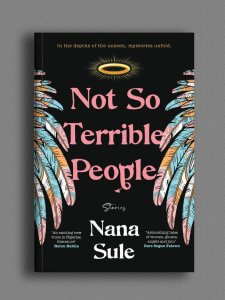
Haneefah: The supernatural and mythological elements in the stories in your book, Not So Terrible People, add a unique layer of depth. What was your approach to incorporating these elements, and what do you hope readers take away from them?
Nana Sule: I don’t think I took any particularly calculated approach to incorporating them; they’re already a part of me. I grew up around stories like these, so they felt natural to tell. As for what readers take away, that’s really out of my control. People will take what they need or see in the stories, and that’s okay. I’m just grateful that they’re reading Not So Terrible People.
Haneefah: Your book explores the relationships between characters, such as Rahila and Ohunene, Ozovehe and his wife. How do you craft these relationships, and what do you hope readers take away from them?
Nana Sule: Again, what readers take away from the stories is really not in my control. For Ozovehe, he was mostly a means to an end. I needed Ohunene, with motivation, to carry and birth that child, and that’s what felt natural at the time.
For Rahila and Ohunene, though, I wanted to show that women can have cordial, beautiful, well-meaning friendships, free of hate or bitterness. I’ve enjoyed these kinds of friendships myself, and I was a little tired of the “women are women’s worst enemies” trope. The truth is, women can be good or “not so terrible”and it isn’t inherently a gender or sex thing. You’ll find women who support you through life’s walks, and you’ll find women who treat you poorly. The same goes for men. It’s a human thing, not a woman thing.
As for how I craft relationships in stories… maybe that’s a small class in itself. Perhaps I should teach a class? I’ve been wanting to do one for a while now.
Haneefah: Ozovehe’s character is portrayed as complex, with moments of tenderness and flaws. Can you discuss your approach to developing his character and what motivates him?
Nana Sule: That’s an interesting question. One way to develop a character is to understand what shaped them as a child… What personal experiences and broader events influenced the way they respond to the world? That’s what I did with Ozovehe. He was deeply affected by the instability in his home and had to act as an emotional shield for his mother and siblings from a young age. Naturally, that takes a toll, especially for someone who didn’t consciously seek therapy or support.
Haneefah: Many characters in your book have flaws and imperfections. How do you balance making characters relatable and flawed while still making them likeable or sympathetic?
Nana Sule: Because that’s how we are as humans. We’re all, in our own ways, not so terrible people, seeking acceptance and hoping for redemption.
Haneefah: Not So Terrible People deal with heavy themes like trauma, grief, and emotional struggles. Can you discuss your approach to writing about these themes and how you balance sensitivity with authenticity?
Nana Sule: I don’t shy away from the heaviness, but I try to approach it as truthfully as I can, remembering that these experiences are part of human life. I draw from observation, empathy, and, sometimes, personal experience, but I always respect the characters’ journeys. I write to show the depth and complexity of people’s lives, letting readers feel without being overwhelmed. Sensitivity comes from care, authenticity comes from honesty.
Haneefah: Your writing style is poetic and evocative. Can you talk about your approach to language and narrative voice in “Not So Terrible People”?
Nana Sule: That’s interesting. Thank you. What I tried to do was simply tell the stories in a way that carried and honoured the characters.
Haneefah : How do you see your work fitting into the broader literary landscape in Nigeria or beyond? What influences or traditions do you draw upon in your writing?
Nana Sule: I see my work as part of a continuum of storytelling… drawing on Nigerian oral traditions, local folklore, and everyday life, while also engaging with universal human experiences. I’m influenced by the rhythms of the languages I grew up with, the stories I heard as a child, and the writers I admire who explore identity, culture, and history. My hope is that my work contributes a perspective that is both rooted in place and open to the wider world, creating connections between local experiences and global conversations.
Haneefah: What are the personal experiences and emotions that you drew upon when writing this book, and how did you channel those into the narrative?
Nana Sule: I drew from growing up in Zaria, witnessing schoolmates being possessed by jinns and undergoing ruqiyya (exorcism). I also drew from my own experiences, like trying to conceive, living with Polycystic Ovarian Syndrome, and coping with pregnancy loss. Writing the stories felt like the right thing to do, even to just release some of the lingering sadness, especially from pregnancy loss.
Haneefah: What is your writing process for this book? Were there any particularly challenging or rewarding moments during the writing journey?
Nana Sule: So yeah, this was interesting to write. I first wrote in bits and pieces and then later wrote the remaining five stories or so in a short period of time. Sometimes it was tough; sometimes it was easy. However, I especially had fun writing on Sunday. I loved writing the parts with him in it… they came to me like a river flows to the sea, naturally. Then some, like Ohunene, took forever and really tested my patience. I wrote it in at least five different ways before settling on diary entries.
Haneefah: What’s next for you as a writer and curator? Are there any upcoming projects or collaborations that you’re excited about?
Nana Sule: What is right before me is the Kano International Poetry Festival. I’m part of the team curating it, and we’ve even surprised ourselves with how amazing it’s shaping up so far. I lie in bed just counting the days to it, and I can tell you for a fact, you should be in Kano too. We have an exciting lineup of guests and activities… There is something for everyone.
Haneefah Abdulrahman is a writer, interviewer, spoken poetry artiste and podcaster from Nigeria whose work has appeared in Nigerian Review, Wisprout Project, Arts MuseFair, and elsewhere. She is a 2021 fellow of Ebedi International Writers Residency, a Pioneer fellow of Imodoye Writers’ Residency, and she was a Columnist at DailyTrust Newspaper. She is the Author of Shades of Becoming. She is the 2021 Winner of The Arewa Rising Literary Star. Born in Kaduna, Haneefah is an indigene of Kogi State. She is a student of English Literature at Ahmadu Bello University, Zaria. Haneefah is the founder of FitzNArtz. She is the Chairperson of the Kaduna Branch, Hill-Top Creative Arts Foundation, the 2021/ 2022 Chairperson of the Creative Writers Club, Ahmadu Bello University, Zaria – Nigeria, the Editor-in-Chief of Literature Voices (LITVO) and the Editorial Assistant of the Moveee Magazine.


